
60's Pulse
A launch-risk dashboard that turns campaign material into objection clusters, stakeholder verdicts, and a fix ladder.
Won Agent Forge AI Hackathon 2026 by making AI criticism feel operational instead of abstract.
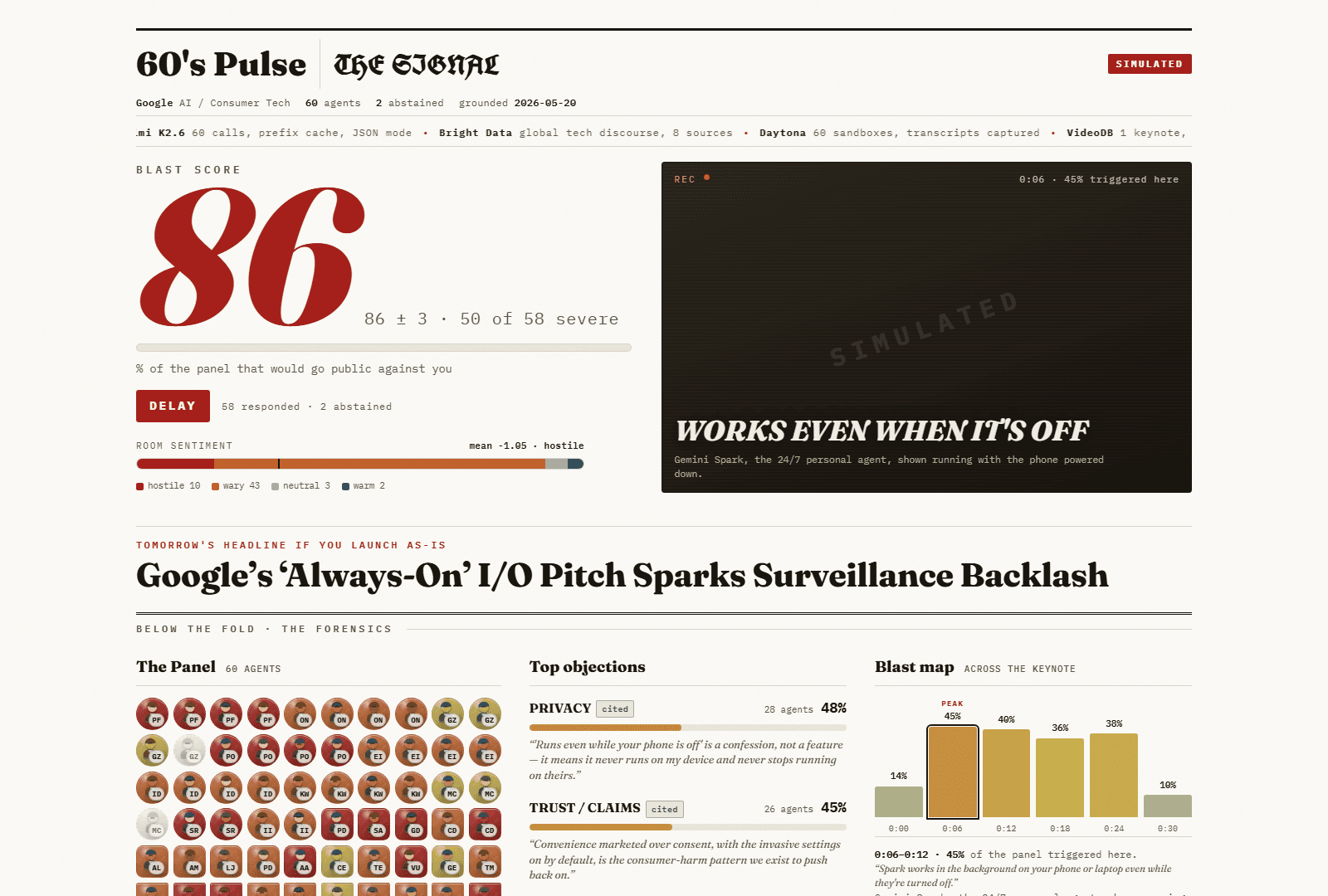

60's Pulse
Built at Agent Forge AI Hackathon 2026, 60's Pulse turns campaign copy, keynotes, images, or videos into a launch-risk war room: Blast Score, 60-agent reactions, objection clusters, blast maps, stakeholder verdicts, and the cheapest fix path.
panel
60 AI critics
result
1st place
mode
demo-safe replay
Quick read
Agent Forge Hackathon Winner: an AI premortem dashboard for pressure-testing product and campaign launches with 60 AI critics before they reach the public.
Pressure-Testing a Launch Before the Internet Does
60's Pulse started from a simple product question: what if a brand could see the backlash path before a campaign went live? Instead of asking whether an idea feels positive or negative, the dashboard asks which specific line, scene, or claim will become the attack surface, who is likely to amplify it, and whether the cheapest fix is copy, production, or a strategic decision.
We built it during Agent Forge AI Hackathon 2026 as a launch-risk war room. The product simulates a 60-agent reaction panel and returns a Blast Score, objection clusters, stakeholder verdicts, a fictional next-day headline, and a fix ladder that separates small wording changes from deeper premise problems.
Sixty Agents, Not One Sentiment Score
The panel is designed for risk coverage rather than polling accuracy. Public personas model everyday sharing behavior, concern lenses inspect sensitive areas in third person, and stakeholder agents represent the people who can turn a bad comment into consequences: journalists, regulators, advocacy groups, employees, competitors, and standards bodies.
Each agent produces a structured reaction with severity, trigger moment, quote, fix tier, and press-conference question. That structure is what lets the dashboard cluster objections, identify the blast map for video, and show where a rewrite can help versus where the underlying premise needs a product or leadership call.
A Demo-Safe Sponsor Stack
The backend is FastAPI with a static dashboard. Its optional live path can use Kimi to orchestrate the panel, Bright Data to ground personas in public discourse, Daytona to capture sandboxed execution receipts, and VideoDB to parse video into scenes, transcript, and a creative manifest. The public demo defaults to a fixture-backed golden replay, so it does not depend on Wi-Fi, sponsor latency, or sixty live model calls.
That tradeoff mattered. A hackathon demo has to be honest about what is live, but it also has to survive the room. The architecture keeps the product story intact while making the demo deterministic: the same dashboard can run from a fixture, a mini live bake, or the fuller sponsor stack when credentials are available.
What I Would Harden Next
The winning prototype proved the core loop: campaign in, objections out, fix path visible. The next version would focus on production-grade trust: clearer source citations per objection, stronger abuse limits on live analysis, deeper video evidence linking, and richer controls for teams to tune the panel to a market, launch channel, or brand-risk profile.
The important lesson was product-shaped: the value is not that AI can generate sixty opinions. The value is that a launch team can stop arguing in vague sentiment terms and see the exact risk surface before it becomes public.
Next case study
InterviewPilot